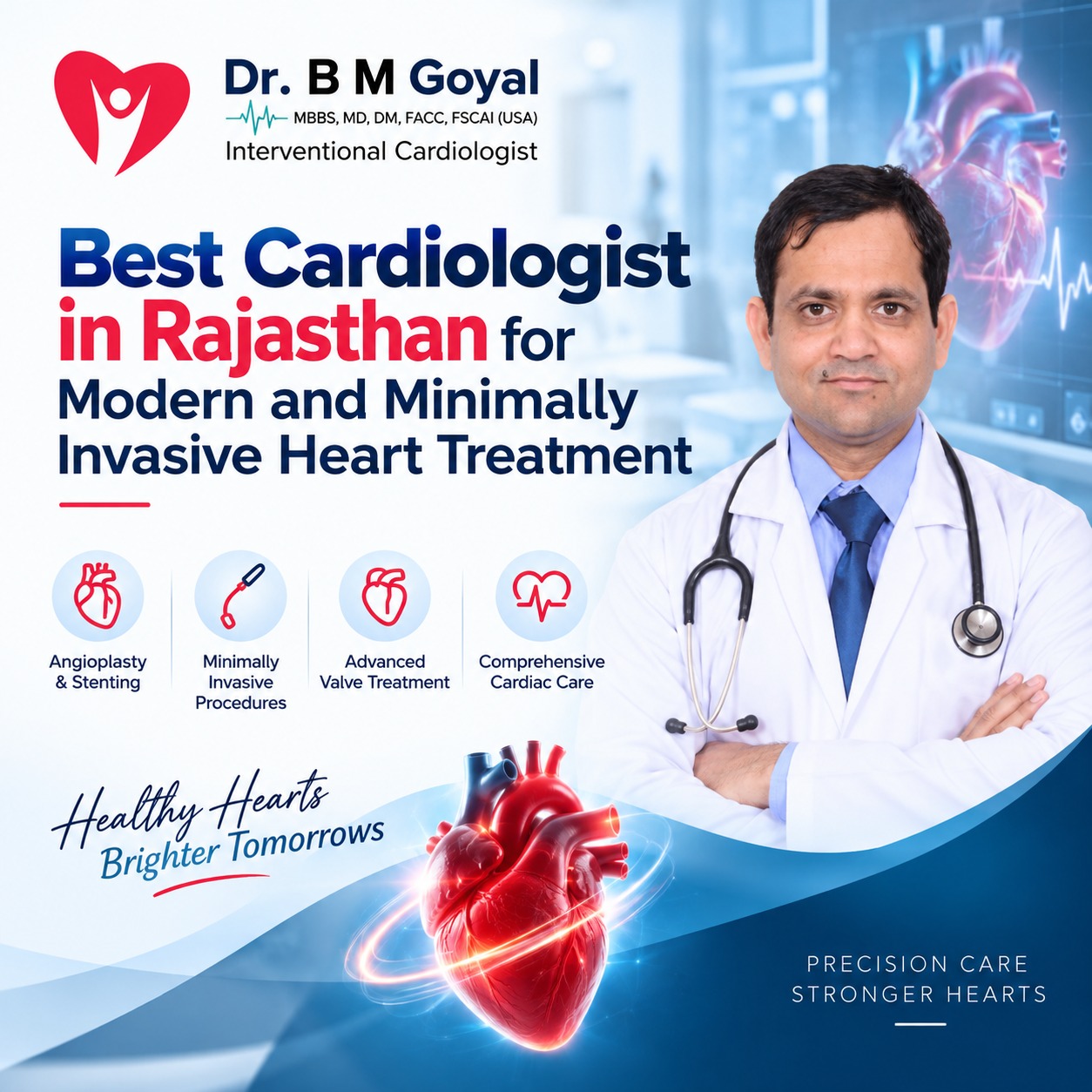
Best Cardiologist in Rajasthan for Modern and Minimally Invasive Heart Treatment
There are different ways in which heart diseases can affect an individual, and the best way of dealing with such a problem would depend on the kind of the condition as well as the level of severity, and also the general wellbeing of the patient and risk factors. With recent developments in the field of cardiology, it is now possible to diagnose as well as treat many types of heart problems using non-invasive techniques where appropriate.
For an individual searching for the Best Cardiologist in Rajasthan, it is necessary to look for more than just the designation of the specialist.
Understanding Modern and Minimally Invasive Heart Treatment
Minimal invasive cardiac treatment usually includes access to the heart or blood vessels via a tiny incision using a thin tube called a catheter. Based on the disease, these procedures can be performed for diagnostic purposes, restoration of blood circulation, and management of some types of arrhythmia and structure defects. Choosing the Best Cardiologist in Rajasthan will allow patients to get a proper assessment and understand what kind of minimal invasive procedure can be recommended for their condition.
For instance, with the help of coronary angiography, doctors will learn about the location and degree of narrowing in the coronary arteries. In case if there is a need for angioplasty, a catheter intervention can be performed in order to restore the proper blood circulation. The type of intervention will depend on the patient's condition, his overall health status, and the recommendation of the attending cardiologist.
What is crucial, minimal invasive treatment does not include the necessity to have any intervention for all patients. In any case, before recommending any type of treatment, doctors need to evaluate the patient's condition.
When Should You Consider an Interventional Cardiologist?
An Interventional Cardiologist focuses on diagnosing and treating certain cardiovascular conditions using catheter-based procedures as well as providing comprehensive cardiac evaluation.
A specialist assessment may be appropriate when a patient has:
-
Persistent or recurring chest discomfort
-
Suspected coronary artery disease
-
Narrowed or blocked arteries
-
Symptoms following a heart attack
-
Certain abnormal heart rhythms
-
Heart failure or reduced heart function
-
A need for angiography or angioplasty
-
A requirement for a pacemaker or other cardiac device
Symptoms alone do not determine the treatment. A cardiologist may consider the patient's medical history, physical examination, ECG, echocardiography, blood tests, imaging, and other investigations before recommending the next step.
Dr. BM Goyal's practice covers interventional cardiology and cardiac conditions including coronary artery disease, heart failure, rhythm disorders and other cardiovascular problems. His website lists angiography, angioplasty, electrophysiology, pacemaker implantation, and ICD/CRTD among his cardiac specialties.
Advanced Cardiac Procedures That May Help Suitable Patients
Modern cardiac care includes several procedures designed for specific medical situations.
Coronary Angiography
Coronary angiography is a diagnostic procedure used to examine the coronary arteries and identify areas of narrowing or blockage. It can help the cardiologist determine whether further treatment may be required.
Angioplasty and Stent Placement
Angioplasty uses a catheter to reach a narrowed coronary artery and, when appropriate, restore blood flow. A stent may be placed to help keep the treated artery open. Whether angioplasty is appropriate depends on the location and severity of the blockage and the patient's overall clinical condition.
Pacemaker Implantation
A pacemaker can help regulate the heartbeat in patients with certain slow heart rates or electrical conduction problems. The type of device required depends on the patient's rhythm disorder and cardiac condition.
ICD and CRTD
Implantable cardiac devices such as an ICD or CRTD may be considered for selected patients with particular rhythm abnormalities or heart failure-related conditions. Device therapy requires careful assessment because indications differ from one patient to another.
These procedures demonstrate how modern cardiac treatment can offer less invasive options for appropriately selected patients, but treatment decisions should always be individualized.
How to Choose the Best Cardiologist in Rajasthan
Searching online for the Best Cardiologist in Rajasthan can provide many results, but choosing the right specialist requires a closer look at the quality and relevance of their medical expertise.
Patients can consider several factors:
Qualifications and specialization: Check the cardiologist's medical qualifications and whether their practice aligns with the cardiac condition requiring treatment.
Interventional experience: If angiography, angioplasty, pacemaker implantation, or another procedure is being considered, experience in interventional cardiology can be an important consideration.
Diagnostic approach: Good treatment begins with an accurate understanding of the condition. The specialist should evaluate the patient's symptoms and investigations before recommending treatment.
Hospital facilities: Complex cardiac procedures may require appropriate procedural, emergency, and post-procedure facilities.
Communication: Patients and families should be able to understand the diagnosis, available options, expected benefits, possible risks, and follow-up requirements.
Long-term care: Cardiac treatment does not always end when a procedure is completed. Medication management, lifestyle changes, monitoring, and follow-up may remain important.
Rather than selecting a cardiologist based solely on a search ranking or promotional claim, patients should consider the specialist's qualifications, relevant experience, treatment approach, and suitability for their individual needs.
Heart Failure Requires Individualized Evaluation and Treatment
Heart failure does not mean that the heart has completely stopped working. It is a condition in which the heart cannot pump blood effectively enough to meet the body's requirements.
Common symptoms can include:
-
Breathlessness, particularly during activity or while lying down
-
Persistent tiredness or reduced exercise tolerance
-
Swelling in the legs, ankles, or feet
-
Rapid or irregular heartbeat
-
Difficulty performing normal physical activities
Heart failure can have different causes, including coronary artery disease, previous heart damage, high blood pressure, valve disease, and certain rhythm disorders. Because the underlying cause and severity vary, treatment also differs between patients.
Management may involve prescribed medicines, lifestyle measures, regular monitoring, treatment of the underlying cause, and in selected patients, device-based or interventional treatment.
Early medical assessment can help identify the cause and severity of heart failure and determine an appropriate management plan.
Choosing the Best Doctor for Heart Failure in Jaipur
If the patient is looking for The Best Doctor for Heart Failure in Jaipur, then it should be a cardiologist who will be able to look at the complete clinical picture rather than just treat symptoms.
The important criteria to consider are whether the cardiologist is experienced in examining the functionality of the heart, establishing the cause of heart failure, checking the medicines, associated ailments, and whether any further cardiological investigations or treatment is required.
The treatment of heart failure usually continues for some time. A good doctor will observe the development of symptoms and the condition of the heart and make necessary adjustments to the treatment.
According to Dr. BM Goyal's professional website, heart failure is a part of the heart disorders treated by him. Moreover, Dr. BM Goyal is an Interventional Cardiologist and Director of Cardiac Sciences in Apex Group of Hospitals.
Why Minimally Invasive Cardiac Treatment Can Be Beneficial for Selected Patients
One of the major developments in modern cardiology has been the expansion of catheter-based treatment. Instead of requiring a large surgical incision, some procedures can be performed through a small access point in a blood vessel.
Depending on the procedure and patient's condition, potential benefits may include:
-
Less extensive access compared with open surgery
-
Reduced physical invasiveness
-
Potentially shorter recovery for appropriate procedures
-
Earlier return to routine activities in selected patients
However, these benefits should not be interpreted as a guarantee of a faster or easier recovery. Every procedure has its own risks and recovery requirements. Age, underlying disease, other medical conditions, procedure complexity, and overall health can all influence outcomes.
A cardiologist should therefore determine whether a minimally invasive approach is appropriate after reviewing the patient's individual condition.
Dr BM Goyal’s Approach to Modern Cardiac Care
Dr BM Goyal is an Interventional Cardiologist working in Jaipur. As per his professional website, he possesses MBBS, MD and DM degrees and is an FACC and FSCAI (USA). As per the website, he is the HOD & Chief Interventional Cardiologist and Director of Cardiac Sciences in Apex Group of Hospitals. The website claims that he has more than 17 years of experience.
The listed specialties of cardiac care include angiography, angioplasty, electrophysiology, pacemaker implantation, ICD/CRTD, coronary artery disease, and heart failure management.
The specialty approach of his practice, as per the website, is diagnosis of the condition, customized cardiac care, and proper selection of treatment depending upon the patient's condition.
When a patient wants to undergo intervention for treatment of the condition, consultation will enable him to understand the diagnosis, different treatment options, pros and cons of the procedure and follow-up post-treatment.
When Should You Seek Immediate Cardiac Attention?
Some cardiac symptoms require urgent medical assessment rather than waiting for a routine appointment.
Seek emergency medical attention for symptoms such as:
-
Severe or persistent chest pain or pressure
-
Sudden or severe difficulty breathing
-
Fainting or loss of consciousness
-
Chest discomfort accompanied by sweating, nausea, or marked weakness
-
Sudden weakness, confusion, or other potentially serious symptoms
The signs of heart attacks may not always be the same for all individuals, as some cases may not involve the typical chest pains experienced during a heart attack. When symptoms are intense, urgent medical attention must be obtained.
Conclusion
Cardiology practice in modern times has increased the number of methods for diagnosing and treating diseases of the heart. The methods such as angiography, angioplasty, pacemaker installation, cardiac devices, among others, may be very useful and even indispensable depending on the specific case.
If one is looking for the Best Cardiologist in Rajasthan, there is much more to it than just the claim qualification, interventional experience, diagnostic methods, available facilities, communication skills and follow-up.
The same applies to the person who needs to find the Best Doctor for Heart Failure in Jaipur, which implies that he or she would need someone to conduct a thorough analysis of the causes, heart performance, symptoms, medications and overall state of health.
Dr. BM Goyal is a specialist dealing with intervention and general cardiac problems in Jaipur, with the listed services covering a number of diagnostic, interventional, rhythm and heart failure related cases.

Hospital Address
Malviya Nagar, Jaipur 302017
Clinic Address
Jagatpura, Jaipur 302017
Phone Number
+91- 9413190570

Designed byNian Technologies